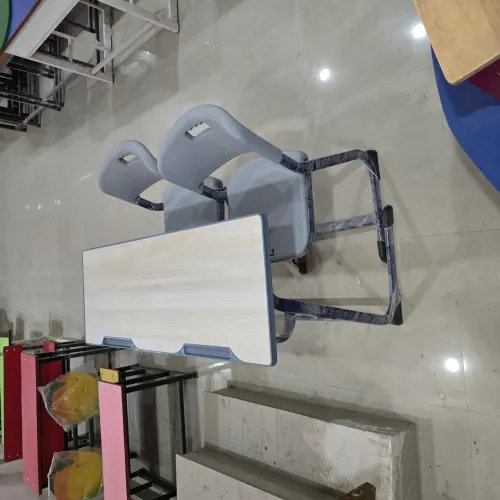
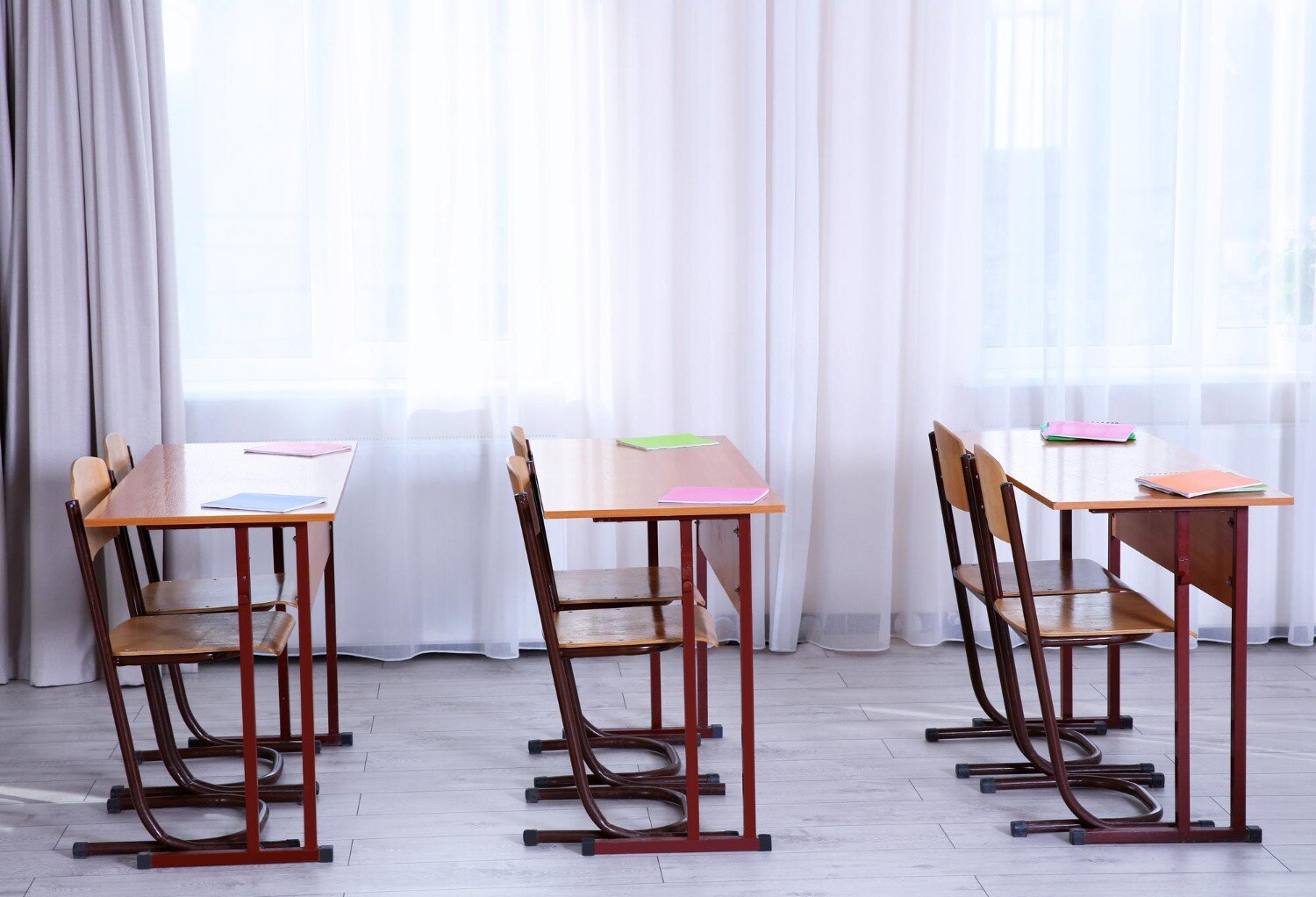
A low price or attractive catalogue image does not show whether a set fits pupils, leaves enough knee room, survives daily cleaning, or can move through your building. By comparing dimensions, layouts, materials, construction evidence, delivery terms, and acceptance criteria, you can create a specification that makes supplier quotes directly comparable.
Key takeaways
- Match table and chair dimensions to pupil height, not class labels.
- Measure usable floor space before choosing two-seater, group or rows-based sets.
- Request material, edge, load, finish and size details in one specification sheet.
- Compare delivery, assembly, replacement and installation terms alongside the unit price.
Match seat and table dimensions to pupil height
A set fits only when its dimensions match the intended pupil height range, not a label such as Class 2, primary, or child size. Ask the supplier for this range before comparing school table and chair sets in Delhi.
| Measurement | What to record | What it reveals |
|---|---|---|
| Chair seat height | Finished floor to the top of the seat | Whether feet reach the floor or a correctly sized footrest |
| Seat depth | Front edge to backrest, with the seat measured from its finished surface | Whether thighs are supported without pressure behind the knees |
| Seat width | Usable width between side edges or arms | Whether the pupil can sit centrally without restriction |
| Table work-surface height | Finished floor to the writing surface | Whether elbows rest naturally while writing |
| Writing surface | Usable width and depth per pupil | Whether books and materials fit without crowding |
Request the pupil height range, then test two adjacent sizes when one class contains noticeably different-sized children. A height-adjustable set works only if its range covers those pupils, the setting cannot slip, and table and chair heights remain compatible.
Check under-table knee and leg clearance, plus the distance between the occupied chair and desk. On two-seater desks, deduct space taken by the central frame, modesty panel, bag hook, or storage before accepting the stated width.
School furniture set specifications that list only overall product height cannot prove ergonomic compatibility. Use EN 1729 Part 1 as a dimensional comparison framework where appropriate, and request the exact standard or test report when compliance is claimed.
Choose the set format for the teaching pattern and room
Choose the format that matches the lesson pattern, not the catalogue photograph. A one-seater gives each pupil a defined writing area and simplifies reassignment, but uses more floor area and creates more units to move.
| Option | Strength | Limitation |
|---|---|---|
| One-seater desk | Personal workspace and easy reassignment | More floor area and movable units |
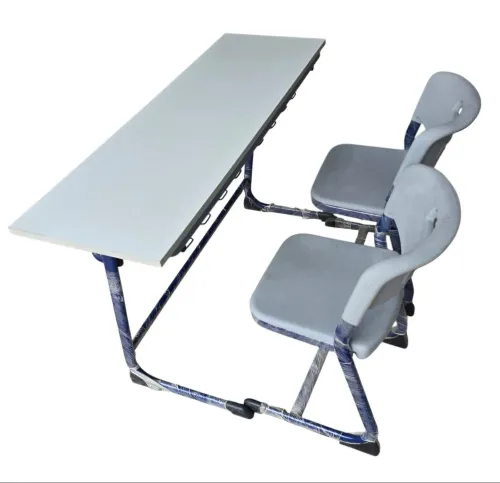
| Two-seater desk | Higher density and shared structure | Less independent repositioning and reduced knee space |
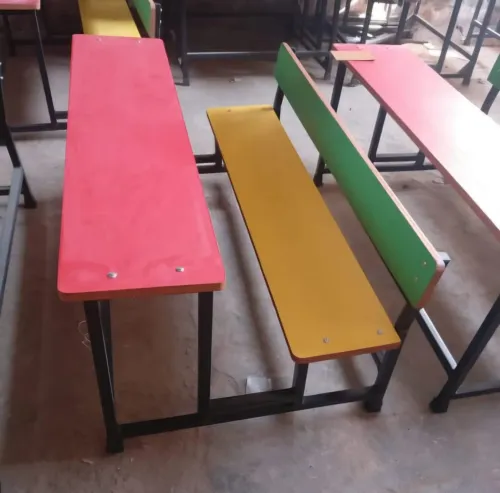
| Bench-and-desk set | Efficient for a fixed arrangement | Replacing one damaged seat is less convenient |
| Separate table and loose chair | Quick room changes and mixed activities | More handling and storage |
| Modular group table | Supports collaborative teaching | Check joining method, edge alignment, stability and storage footprint |
Compare fixed-height, adjustable-height and age-specific furniture against pupil turnover. Fixed-height sets are robust and straightforward when one height band uses the room; they are the wrong choice when several age groups share it.
Adjustable furniture suits mixed cohorts only when its range covers the pupils, the mechanism cannot shift accidentally, and the table remains compatible with each chair setting.
Age-specific furniture offers a closer fit with less mechanical complexity, but becomes inefficient when enrolment changes frequently. Loose chairs help convert a room from writing to discussion, yet require a storage plan and disciplined handling. For school tables and chairs in Delhi, state whether you need single-pupil, two-pupil or group-table furniture before comparing prices.
A nominal width per pupil can hide a central frame, modesty panel, bag hook or under-table storage that removes writing and knee space.
Measure the classroom before calculating capacity
The number of sets that fit is the number that preserves movement, access, and teaching space—not the supplier’s catalogue capacity. Measure the room length and width, then record these constraints:
1. Measure the door width, lift dimensions, stair width and landings, columns, wall projections, windows, cupboards, storage, teacher zone, and wall clearance required for boards or circulation.
2. Draw the room to scale and place the actual desk footprint, chair pull-out zone, teacher movement area, bag storage, and equipment storage on it. Show door swings, emergency routes, cleaning access, and windows or cupboards that the last row must not block.
3. Set the required aisle width in the tender instead of accepting a supplier’s figure. Subtract fixed obstructions and teacher space, divide the usable width into desk-and-aisle modules, then test that arrangement across the room depth.
4. For a two-seater, count two writing positions only after deducting frame intrusion, central dividers, bag hooks, storage, and lost knee space. For group tables, count seats that remain accessible with chairs pulled out, not seats arranged around an empty tabletop.
5. Count complete institutional table chair sets, spare chairs, and packaging units that can enter the building and reach the assembly location. Include delivery, packaging removal, and transit-damage replacement in the site plan.
Attach an acceptance drawing showing the intended arrangement and the maximum permitted sets in each room. Evaluate the installed layout, not isolated catalogue dimensions.
Demand a complete specification and inspect a production sample
Demand a complete specification and inspect a production sample before ordering; appearance proves little about classroom durability. Your school furniture set specifications should show the full structure, dimensions, materials, finish, safety evidence, and packed size.
- Request overall dimensions, chair seat height, table work-surface height, seat depth and width, writing-surface dimensions, under-table clearance, load rating, floor protection, and packed dimensions.
- Specify material thickness, frame section, exact steel grade or tube construction, fastener type, edge treatment, finish, pretreatment, coating system, and coating thickness. Do not accept “powder-coated MS” as a complete finish description.
- For laminated board, identify plywood, MDF, or particleboard; state board thickness, edge sealing, screw-holding design, and resistance of exposed edges to water and impact.
| Material | Useful strength | Limitation to compare |
|---|---|---|
| Plywood | Repairable and more moisture-tolerant | Costs and weighs more |
| Laminated board | Cleanable writing surface | Edges can lift or swell |
| Solid wood | Repairable mass | Heavy and needs finish maintenance |
| Steel | Strong structural frame | Needs corrosion protection |
| Plastic | Light and easy to clean | Can deform or crack under impact |
Inspect the production sample for weld spatter, weld continuity, exposed screw heads, sharp corners, splinters, laminate lifting, cracked edges, uneven legs, rocking, loose fasteners, seat-to-frame separation, and chair-to-desk alignment. Test the complete load path from seat and back attachments through welds or fasteners to floor contacts.
For preschool furniture, check radiused edges, captive or inaccessible fasteners, wide stable footprints, and finger-trap risks. Request the exact standard and test report behind any compliance claim; EN 1729 Part 2 provides a useful safety comparison. Define dimensional tolerances, maximum rocking, coating defects, inspection quantities, missing hardware, and rejection or replacement steps in the tender.
Compare the supplier’s installed obligation, not only the unit price
Compare the total installed obligation, not the ex-factory price. Ask every classroom table chair supplier to quote against the same dimension sheet, material schedule, finish sample, production sample, packed dimensions, installation method, delivery programme, and room-by-room quantity.
| Quote element | What to verify | What can add cost |
|---|---|---|
| Access | Floors, lift dimensions, stair width, doorways, and assembly locations | Manual carrying, site assembly, or storage |
| Delivery | Programme, packaging removal, and damage-replacement process | Delays and unusable units |
| Furniture | Finish sample, production sample, actual dimensions, and compatibility | Rework after bulk manufacture |
| Quantity | Room-by-room sets, spares, and packed volumes | Short deliveries or excess storage |
Inspect the production sample for edge sealing, corner radius, weld spatter, sharp edges, rocking, chair-table alignment, and measured seat and table heights. Define acceptance criteria in writing: permitted dimensional deviation, maximum rocking, coating defects, missing hardware, inspection quantity, rejection procedure, and replacement deadline.
- Separate manufacturing defects from misuse and consumable damage.
- State the service response time, on-site repair responsibility, spare-part availability, finish or colour-mismatch coverage, and defect-reporting process.
- Request classroom-use references or inspection evidence, not only adult-office installations.
Indera Furnishers should be assessed through the same sample, specification, access plan, and service evidence as competing bidders. For school table and chair sets in Delhi, link payment milestones to approved samples, delivered quantities, dimensional checks, and punch-list closure.
Keep the signed specification and accepted sample with the purchase order so replacements match what you approved.
Frequently asked questions
How do you match school table and chair dimensions to pupil height?
Ask for the intended pupil height range and compare seat height, seat depth, table height and clearance against that range rather than relying on labels such as Class 2 or primary.
Which school table and chair set format suits a classroom?
Choose two-seater desks, individual tables, group tables or row-based sets according to the teaching pattern, circulation routes, storage needs and available room shape.
What should you measure before calculating classroom furniture capacity?
Measure the usable floor area, door swings, columns, fixed cupboards, teacher space and required aisles before deciding how many sets the room can hold.
What should a school furniture set specification include?
Request dimensions, frame material, panel material, edge treatment, surface finish, fasteners, load rating, chair details, safety features and the intended pupil height range.
What installed obligations should you compare between suppliers?
Compare delivery access, unloading, assembly, placement, site protection, installation timing, snag correction, replacement parts and warranty support, not only the unit price.
Keywords