A wooden desk is worth the investment only when its board material, sealed edges, joints, dimensions, and maintenance requirements match a coaching centre’s daily workload. By comparing desk types and checking construction, room fit, student ergonomics, and Delhi’s climate, you can decide whether wood delivers lower lifetime cost or merely a higher purchase price.
Key takeaways
- Choose sealed plywood, reinforced joints and replaceable hardware for daily classroom use.
- Reject desks with thin MDF, exposed edges, loose joints or no repair support.
- Measure aisles, chair clearance and door access before fixing the desk quantity.
- Specify dimensions, edge treatment, load needs, warranty and replacement parts in writing.
When Does a Wooden Desk Beat the Alternatives?
A wooden desk beats the alternatives when your coaching centre needs daily durability, repairable parts, stable writing surfaces, and a professional room that will be reused for years. It is poor value when “wooden” hides thin MDF, unsealed edges, weak joints, or no replacement hardware.
| Option | Value advantage | Limitation and best fit |
|---|---|---|
| Wooden desk | Repairable panels, firm writing surface, replaceable hardware, warmer appearance | Choose sealed plywood or solid wood for heavy use; specify the core, coating, edges, and joints |
| Metal-frame desk | Strong frame, lighter cost, easy relocation | A thin top can swell or chip; best when rooms are rearranged often |
| Engineered-wood desk | Consistent, flat surface at a lower price | MDF and particleboard hold screws poorly at damaged edges; request the board’s emission declaration |
| Plastic desk | Easy cleaning and low weight | Scratches, flex, and limited repairability make it weaker for intensive adult study |
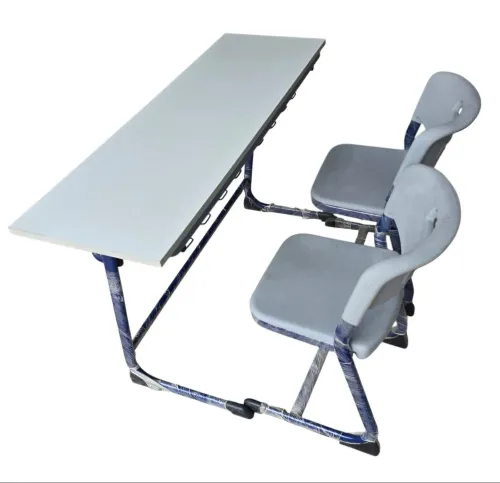
| Tablet-arm chair | Maximum aisle flexibility and high seating density | Small writing area, poor support for books, and awkward long sessions |
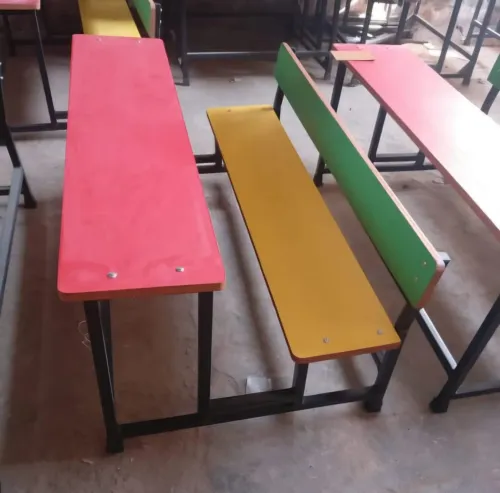
| Bench-desk combination | Efficient capacity and fewer components | One student’s movement disturbs others; replacement becomes costly when one joined unit fails |
For coaching centre study furniture, compare total service life rather than purchase price. A wooden study desk for coaching centres in Delhi earns its premium in long-running classrooms if it survives repeated cleaning, dismantling, and batch changes. In narrow rooms or frequently rearranged halls, metal frames or tablet-arm chairs can deliver better value.
Match every desk with the correct chair height; a durable top cannot correct raised shoulders, unsupported feet, or a hunched posture.
Which Materials and Construction Details Survive Delhi Conditions?
“Wooden” does not identify the desk’s core. For wooden study desks for coaching institutes, ask what lies beneath the finish, because solid wood, plywood, MDF and particleboard fail differently. Laminate-faced board describes a surface finish over a core; veneer is a thin real-wood layer over a board or plywood, not solid timber.
| Material | How to identify it | Delhi-use implication |
|---|---|---|
| Solid wood | Continuous grain through the section; no visible layered plies | Repairable and refinishable, but expands and shrinks with humidity and heat |
| Plywood | Multiple thin layers visible on an exposed edge | Strong screw holding and better resistance to dismantling |
| MDF | Fine, uniform brown fibres with no layers | Flat and smooth, but edges absorb moisture and hold screws less reliably |
| Particleboard | Coarse compressed chips visible at a cut edge | Lowest-cost option; swelling and joint failure follow water exposure |
| Laminate-faced board | HPL or melamine sheet bonded over MDF, particleboard or plywood | Resists writing abrasion and wiping only when edges are sealed |
| Veneer | Thin natural-wood skin over a board core | Looks like wood; chipped or unsealed edges expose the weaker core |
Specify these construction details before comparing prices:
- Use sealed edges on every side, including the underside; ABS or PVC edge banding should be bonded firmly and replaceable after damage.
- Choose bolted or threaded-insert joints for repeated dismantling, not screws driven into MDF alone.
- Require a hard-wearing, cleanable laminate or coating, rounded corners, and no exposed veneer at writing edges.
- Ask for treatment records covering wood, board and cut edges; polish alone is not termite treatment.
- Fit adjustable levelling glides so uneven floors do not twist the frame, and request the actual board’s formaldehyde emission class or test report.
How Many Desks Fit the Room Without Making It Unusable?
Plan from usable clearances, not wall-to-wall area. A study desk for learning centres in Delhi needs a matching chair, at least 600 mm of seat width per student, and enough knee space to keep shoulders relaxed. Allow 900 mm for the main passage and 600–750 mm between desk rows where movement is occasional.
| Layout | Desk and aisle planning | Best use |
|---|---|---|
| Individual desks | 600–750 mm wide by 450–600 mm deep; keep 900 mm main aisle | Frequent rearrangement, tests, mixed class sizes |
| Two-student bench | About 1,200 mm wide by 450–600 mm deep; preserve a clear end aisle | High-density lectures with stable seating |
| Perimeter or paired rows | Keep 750–900 mm turning space at the door and teacher zone | Narrow rooms needing controlled circulation |
Give each student a writing surface at least 600 mm wide and 450 mm deep. A 600 mm depth works better when learners use textbooks, notebooks, and a laptop; shallow tops push materials into the aisle.
- Measure the room after skirting boards, pillars, fans, doors, and storage are accounted for.
- Keep bags off the floor with an under-desk shelf or rear hook, but avoid fixed cupboards that block legroom or prevent layout changes.
- Use individual desks when batches change, absent-student gaps matter, or the room alternates between lectures and tests.
- Choose bench desks only when their lower cost outweighs difficult repairs and permanently fixed seating.
- Mark a trial layout with tape and walk every route before ordering. A dense plan that cannot support cleaning, evacuation, or batch turnover is not usable capacity.
How Do You Check Student Fit and Daily Classroom Performance?
Test the desk and chair together with the actual student age range, not with an empty showroom display. Each student should sit with feet supported, knees clear of the underside, shoulders relaxed, forearms resting near the writing surface, and the trunk upright rather than folded over the desk.
Use three students from the shortest, middle, and tallest expected age or height group. Reject a fixed-height pairing if the smallest student’s feet dangle or the tallest student’s knees strike the panel. A wooden desk for coaching classrooms needs open space beneath it; a full modesty panel can block feet, bags, sweeping, and quick exit.
Check daily operation with a loaded classroom:
- Push chairs fully in, then walk the planned aisle without turning sideways.
- Sweep or mop beneath and between desks; confirm no pedestal, shelf, or crossbar traps dust.
- Move ten desks through the room and inspect whether joints loosen, edges chip, or floors get scratched.
- Run a batch change with bags present; hooks and shelves must not obstruct knees or evacuation paths.
- Ask students to write for 20 minutes; hunching, raised shoulders, or repeated repositioning signals a poor fit.
| Option | Strength | Trade-off |
|---|---|---|
| Individual desks | Flexible spacing, replacement, and layouts | Higher cost and more pieces to move |
| Two-student benches | Lower cost and fewer floor gaps | One damaged frame affects two seats |
| Tablet-arm chairs | Fast rearrangement and minimal footprint | Small writing area, limited support, and awkward longer sessions |
Choose open-leg construction when cleaning and batch turnover matter more than concealed storage.
What Should a Delhi Coaching Centre Put in the Purchase Specification?
A tender that says “wooden desk” is incomplete. Specify the core material, board thickness, laminate or coating, sealed edges, fasteners, dimensions, and termite treatment separately for coaching centre study furniture.
For a wooden study desk for coaching centres in Delhi, name EN 1729-1 only as a dimensional reference, including the furniture size category; “ergonomic” alone proves nothing.
- Require a sample to pass repeated-use checks: corner leaning and racking, chair impacts, relocation, edge knocks, and repeated tightening of joints. Record wobble, cracked panels, stripped inserts, and loose fasteners after testing.
- Request the actual board emission class or laboratory report for MDF, particleboard, and plywood supplied. Laminate covers the surface; it does not prove low formaldehyde emissions.
- Specify treatment records identifying treated components, protected cut edges, treatment date, and inspection or retreatment procedure. Polish is not termite treatment.
- Put repair terms in writing: replacement tops, legs, edge strips, inserts, bolts, and finish-matched panels; response time; labour charges; and warranty exclusions.
| Supplier claim | Evidence to demand | Warning sign |
|---|---|---|
| Solid wood | Species, moisture range, section sizes, joint detail | High price with thin parts or unsealed end grain |
| “Ergonomic” | EN 1729-1 category, desk and chair measurements | No size category or measured drawing |
| “Heavy duty” | Test method, cycle count, failure limits | Static load only |
Ask Indera Furnishers for the same drawings, test evidence, treatment records, and spare-part schedule you would request from any supplier. That comparison reveals value better than finish or sales language.
Related products
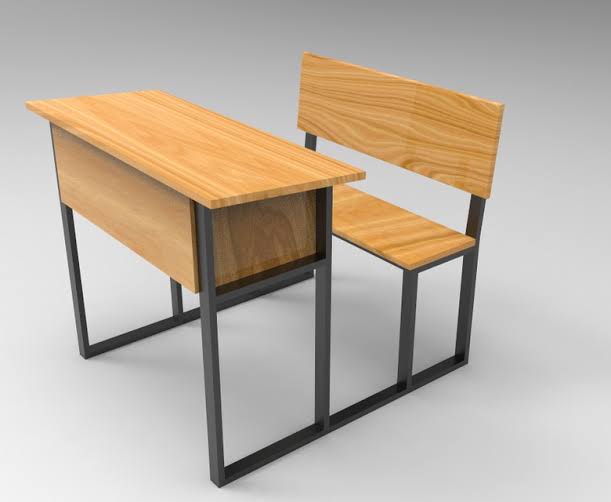 | Wooden Study Desk ₹2200 The Wooden Study Desk by Indera Furnishers is a robust and stylish learning desk crafted from premium-quality wood for long-lasting durability. View product → |
 | Wooden Student Desk ₹2300 The Wooden Student Desk from Indera Furnishers is a sturdy and ergonomic study solution crafted for schools, colleges, and learning centres. View product → |
Frequently asked questions
When does a wooden desk beat metal or plastic alternatives?
Choose wood when you need a stable writing surface, repairable parts, lower noise and a professional room finish that will be reused for years. Compare total maintenance effort, not material labels alone.
Which wooden desk materials survive Delhi coaching-centre conditions?
Ask whether the desk uses plywood, particleboard or MDF, then inspect edge sealing, laminate adhesion, joint reinforcement and moisture protection. Exposed edges and weak fasteners are failure points in frequent-use classrooms.
How can a coaching centre fit more desks without making the room unusable?
Measure the room, columns, doors and circulation paths first. Reserve clear access to every row and keep enough space for students to sit, stand and move without scraping adjacent desks.
What should a purchase specification for coaching classroom desks include?
Write the desk dimensions, material and thickness, surface finish, rounded-edge requirement, frame or joint construction, load expectation, hardware, warranty, delivery terms and availability of replacement parts.
Related products
 | School Desk ₹2200 Ergonomic Chairs: Designed to promote good posture, these often feature a contoured seat and back (to support the lumbar spine) and a “waterfall”... View product → |
 | School Furniture Desk ₹3850 Indera Furnishers’ School Furniture Desk is designed to provide students with a safe, comfortable, and productive learning environment. View product → |
 | Student Desk and Chair Set Ergonomic Student Desk and Chair Set ₹1850 Well-designed desks, benches, and chairs are important for a contemporary classroom. View product → |
 | student desk bench ₹2200 Well-designed desks, benches, and chairs are important for a contemporary classroom. View product → |
Keywords